
Why Gas Prices Moved Before Oil Did
What the refinery bottleneck tells us about food, chips, and the next recession

When crude shipments from the Persian Gulf get disrupted, one of the first things a refinery operator often does is cut throughput. Shutting a refinery down entirely is expensive and operationally risky, so operators tend to reduce output, sometimes to a fraction of capacity, while they figure out whether replacement crude is coming and whether their economics still work.
The result can be rapid. When enough refinery capacity comes offline or cuts rates, the supply of refined products (gasoline, diesel, jet fuel) tightens before crude oil prices have fully reacted. Pump prices can spike. And if you’ve been watching WTI or Brent futures wondering why your gas station already moved, the refinery step is a big part of the answer. In this situation, the bottleneck isn’t the well. It’s the refinery.
Traders call the gap between crude oil prices and refined product prices the crack spread, the margin a refinery earns by “cracking” crude into usable fuels. When refinery throughput drops, the crack spread tends to widen because refined product becomes scarce even if crude hasn’t fully repriced. Other factors move the spread too (seasonal fuel specs, product inventories, export flows), but refinery disruptions are among the most visible drivers. For consumers, the crack spread captures part of the gap between the headline crude price and the number on the pump, alongside taxes, blending, transportation, and retail margins.
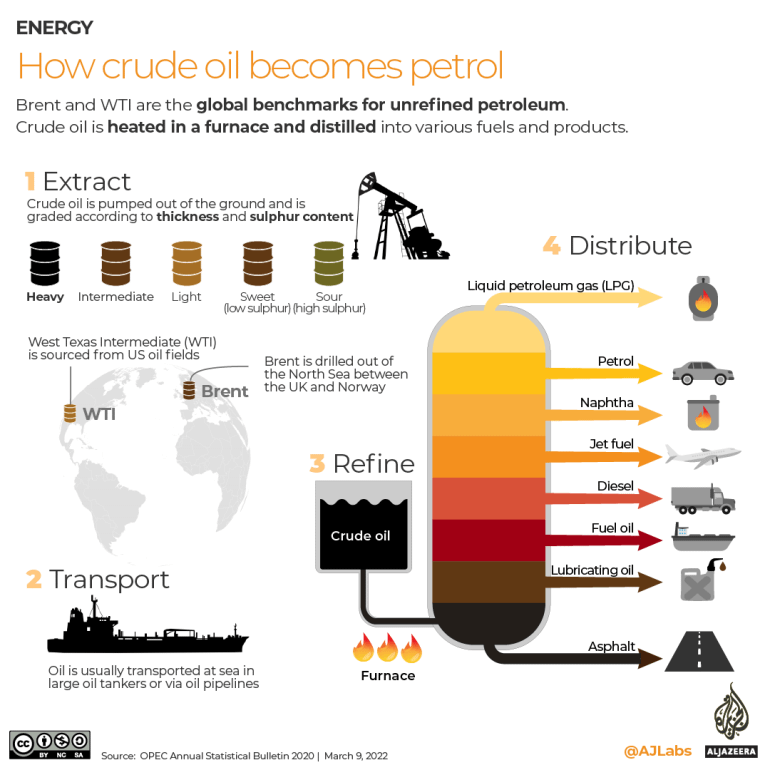
This is the first of five links in a chain that connects an oil supply disruption to your wallet. Most of the damage happens in links that never make the evening news.
Oil is not oil
The second link trips up almost every policy conversation about energy independence.
Crude oil is not perfectly fungible. Venezuelan crude is thick and heavy, requiring specialized refineries and extensive processing. Crude qualities vary sharply even within a region. UAE Murban is light and sweet, flowing easily and yielding more gasoline per barrel. But most Saudi crude is medium sour, with higher sulfur content that requires different refinery configurations. U.S. shale crude has its own profile. Gulf Coast refineries were built for specific crude slates, and switching from one source to another is constrained by economics and equipment, not just price.
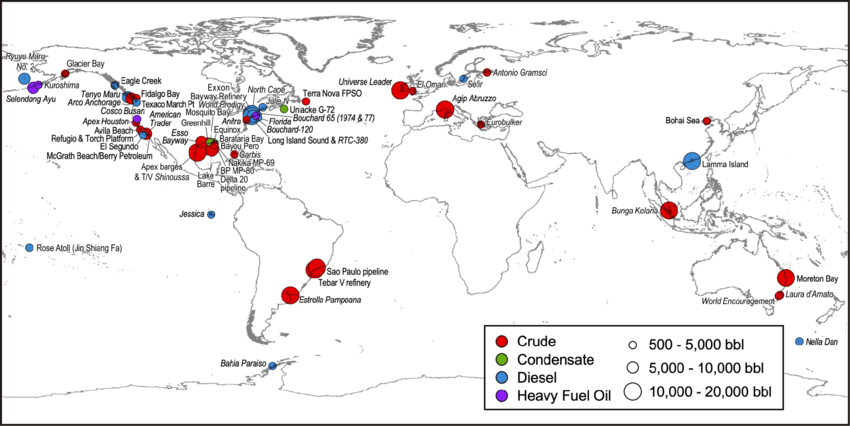
This matters when people say the United States is energy independent. The U.S. became a net total petroleum exporter in 2020, and it exports both crude and refined products. But it remains a net crude oil importer and still brings refined products into some coastal markets. The West Coast is particularly isolated. There’s no direct product pipeline from Gulf Coast refineries to California, so the region depends on waterborne imports and local refining. The East Coast is better connected through the Colonial and Plantation pipeline systems, but regional constraints still create price dislocations during disruptions. Being a net petroleum exporter does not insulate American consumers from fuel price spikes, because the refinery step, crude-quality mismatches, and the geography of fuel distribution all create separate bottlenecks.
Even the domestic energy system has infrastructure gaps that most people don’t realize exist. Pipelines curtailed or restricted the flow of natural gas to manufacturers more than 40 times last year, per Industrial Energy Consumers of America, a trade group representing over 12,000 U.S. manufacturing facilities.[1] During one winter storm, spot gas prices in parts of the Northeast and Midwest surged to multiples of normal levels.[1:1] The U.S. has become the world’s largest exporter of liquefied natural gas while its own factories sometimes can’t get fuel.[1:2] Oil has a version of the same structural problem.
The break-even economics reinforce the mismatch. Saudi Aramco’s upstream lifting cost (the cost of extracting a barrel from an existing well, excluding capital investment) runs in the range of $3 to $4 per barrel of oil equivalent, among the lowest in the world.[2] U.S. shale is a different story. The Dallas Fed’s 2025 energy survey put the average break-even price for drilling a new well in the low $60s per barrel, though large producers with scale advantages report lower numbers.[3] As prices rise, previously uneconomic wells become viable and new supply comes online. But “eventually” can mean months, not weeks. And the new supply still has to reach a refinery configured to process it.
The supply chains nobody’s watching
A Gulf energy disruption doesn’t just hit fuel. Oil and natural gas production are closely linked in the region, and natural gas feeds supply chains that most people would never connect to an oil shock. Two of them matter right now.
Fertilizer. Natural gas is the primary feedstock for ammonia-based fertilizers. Qatar accounts for roughly 14% of global urea supply, according to QAFCO, and the broader Gulf and Middle East region supplies closer to 30% of internationally traded fertilizer.[4][5] A disruption that chokes Gulf gas production during spring planting season creates a problem with a built-in delay. Fertilizer that isn’t available in March and April can show up as reduced crop yields months later. The agricultural calendar doesn’t wait for shipping lanes to reopen.
Helium. This one is less intuitive. Helium is a byproduct of natural gas processing, and Qatar is one of the world’s largest suppliers of the high-purity helium used in semiconductor manufacturing.[6] Chip fabrication uses helium in lithography cooling and quality testing. The semiconductor industry was already squeezed by AI-driven demand for memory and compute chips. A Gulf disruption that tightens helium supply compounds an existing bottleneck in a supply chain that appears to have nothing to do with energy.
Food is just energy with extra steps
Fuel prices bleed into food prices through two channels. The first is fertilizer (already covered). The second is transportation. Most freight trucking, most rail shipments, and most cargo vessels run on diesel or petroleum-based fuels. When diesel prices spike, distribution costs spike with them. And food is fundamentally a distribution problem as much as a production problem. The world produces enough aggregate calories, but getting them to the right place at the right price (and in the right season, given weather, conflict, and local agronomy) is where the system strains.
This is why analysts and the Fed tend to focus on “core” inflation measures that exclude food and energy. The BLS publishes both headline CPI and a separate all-items-less-food-and-energy index. The rationale is that food and energy are volatile and driven by supply shocks that monetary policy cannot readily offset. But for households, especially lower-income households, food and transportation are among the largest spending categories after housing. When both spike simultaneously from the same upstream cause, the squeeze on discretionary spending is severe. I wrote about how inflation hits different income levels differently last year. The mechanism is identical here.
The Federal Reserve’s January 2026 Beige Book put it plainly. Spending was “stronger among higher-income consumers” on luxury goods and travel, while low-to-moderate income consumers were “increasingly price sensitive and hesitant to spend on nonessential goods and services.”[7] An oil shock amplifies exactly this divergence. A tech worker who works from home barely notices a 30% diesel increase. A warehouse associate commuting 45 minutes each way absorbs the full impact. Oil-price shocks tend to be regressive because lower-income households spend a larger share of their income on energy-related necessities. The aggregate CPI print masks a lived experience that varies enormously by income and geography.
The sequel that’s already written
The fifth link is the one that investors should be watching most closely.
Demand destruction tends to follow major oil price spikes, though the timing and magnitude vary by cause, macro backdrop, and policy response. The cycle runs like this. Prices spike. Producers rush to bring new supply online as previously uneconomic wells become viable. New drilling starts. Delayed projects get approved. At the same time, consumers cut where they can. Businesses find substitutes, reduce consumption, or pass costs through until demand contracts.
The investment in new supply takes time. New refinery capacity in particular can take many years from permitting through construction, and that lag creates a mismatch. By the time new capacity arrives, consumer demand has often already pulled back. The result, historically, is a glut. After oil spiked above $140 per barrel in mid-2008, prices collapsed to under $40 within six months as demand cratered and new production commitments made during the boom began to flow. After the 2014 spike, U.S. shale producers kept drilling into a falling market, contributing to a global oversupply that took years to clear. Many of the largest oil oversupplies came after large demand spikes. How quickly this cycle plays out in the current disruption depends on variables that are hard to pin down (SPR releases, OPEC+ spare capacity decisions, the speed of alternative sourcing), but the pattern itself is well-established.
Every oil shock contains the seed of the glut that follows it.
Oil shocks have also preceded multiple U.S. recessions. The mechanism is straightforward. Fuel demand is relatively inelastic in the short run, meaning households cut other spending before they cut driving. So higher fuel costs crowd out discretionary purchases. Consumer staples hold up. Cyclicals get hit. Persist long enough, and the spending compression can tip into contraction. After oil prices collapsed in 2014, U.S. oil and gas production employment fell roughly 16% within a year.[8] The cycle runs in both directions.
What to watch
If you’re following this situation, the crack spread can be a more useful signal than the WTI crude price alone, especially during refinery-driven shocks. When the gap between crude and refined product widens, pump prices are moving faster than the headline number suggests. Watch refinery utilization rates (published weekly by the EIA) for signal on severity. Watch fertilizer prices if you want a leading indicator of food inflation, though the exact lead time depends on the crop, region, and farmer inventories. And track the demand destruction cycle, because the oversupply that historically follows a spike can reprice energy equities that the current panic may be mispricing.
A specific prediction falls out of this analysis, and it’s testable. If the Gulf disruption persists through spring, fall crop yield reports and winter food price data should reflect the fertilizer squeeze. If they don’t (because alternative fertilizer sources filled the gap, or because the disruption resolved quickly), that tells us the supply-chain link is weaker than this framework assumes.
Even in an optimistic scenario, where the conflict ends soon and shipping lanes reopen, full normalization of oil markets would take time. Some Qatari LNG infrastructure damage has been reported as potentially requiring years to repair.[9] Clearing shipping lanes, rebuilding inventories, and recalibrating investor risk appetite for Gulf-sourced energy don’t happen overnight. The system has inertia in both directions.
The pattern is older than any of us. An oil shock transmits through refinery margins, crude substitution constraints, energy supply-chain dependencies, consumer prices, and demand destruction. The links are well-established. The timing varies. But if the cycle holds, the crack spread will start narrowing before the headlines catch up. In past disruptions, it has tended to move first on the way up. It may well move first on the way down.
This is general education, not financial advice. Your situation is different from everyone else’s, and this analysis does not account for it.
The Wall Street Journal, “The U.S. Is Awash in Natural Gas, but American Factories Still Can’t Get Enough”, February 10, 2026. https://www.wsj.com/finance/commodities-futures/lng-us-manufacturers-no-fuel-6c8e48ae
Reuters, “Saudi Aramco: The Oil Colossus,” May 30, 2024. Saudi Aramco, H1 2025 results presentation.
Federal Reserve Bank of Dallas, “Energy Indicators,” May 1, 2025. Federal Reserve Bank of Dallas, Energy Slideshow, March 3, 2026.
QAFCO (Qatar Fertiliser Company), corporate overview, accessed March 2026.
Reuters, “How Does the Iran War Affect Fertiliser Supplies, Prices and Food Security?” March 17, 2026. International Fertilizer Association, “Protect Fertilizer Supply Chains to Safeguard Global Food Security,” March 16, 2026.
Reuters, “Helium Prices Soar as Qatar LNG Halt Exposes Fragile Supply Chain,” March 12, 2026. U.S. Geological Survey, Mineral Commodity Summaries 2026: Helium and Rare Gases, February 2026.
Federal Reserve, “Beige Book Summary, January 2026.” Original: https://www.federalreserve.gov/monetarypolicy/beigebook202601-summary.htm
Reuters, “U.S. Oil, Gas Industry Sheds 100,000 Jobs in Slump: Kemp,” February 4, 2016. U.S. Energy Information Administration, “Oil and Natural Gas Production Job Declines Tend to Lag Oil Price Declines,” Today in Energy, June 23, 2015.
Reuters, “Cheniere, Venture Global Shares Surge amid Iran Attacks on Qatar LNG Infrastructure,” March 19, 2026.